Could a hidden patch of moisture actually lead to the immediate suspension of your childcare license under the January 2026 strengthened Quality Area…
Could a hidden patch of moisture actually lead to the immediate suspension of your childcare license under the January 2026 strengthened Quality Area 2 obligations? You already know that keeping your facility safe, clean, and in good repair as per Regulation 103 is a non-negotiable part of your daily operations. Booking a professional childcare centre mould assessment Sydney is often the only way to quiet the anxiety of a surprise inspection or a child’s respiratory flare-up. It’s a heavy burden to carry alone, but ensuring your indoor air is well ventilated and spore-free is critical for your next NQS rating.
This guide provides everything you need to meet the latest health standards and protect your licensing. We’ve simplified the confusing regulatory landscape into a clear, actionable path to compliance. You will find a complete 2026 safety checklist, a breakdown of professional inspection costs which typically start at $1000 for commercial facilities, and a guide to the industry leading Goldmorr remediation system. We’ll show you how to get a clear pass on your mould clearance report with minimal disruption to your centre operations. It’s that simple.
Key Takeaways
- Learn why Sydney’s 2026 humidity patterns demand a proactive approach to protect developing respiratory systems and ensure regulatory compliance.
- Discover the critical areas for a childcare centre mould assessment Sydney, including nappy change stations and hidden leaks identified through thermal moisture mapping.
- Understand the liability risks of DIY “bleach fixes” and why professional remediation is essential to avoid staff or child health complications.
- Master the communication strategy for parents and staff to provide peace of mind during the assessment process without disrupting your centre’s schedule.
- Find out how the Goldmorr System effectively eliminates both surface growth and invisible airborne spores to maintain a safe, clean environment.
Table of Contents
- Why Childcare Centre Mould Assessment in Sydney is Critical in 2026
- The Essential Childcare Mould Assessment Checklist
- Professional Assessment vs. DIY: Meeting Sydney Standards
- Preparing Your Centre for a Mould Inspection
- The Goldmorr Solution: Safe Remediation for Sensitive Spaces
Why Childcare Centre Mould Assessment in Sydney is Critical in 2026
Mould isn’t just an aesthetic issue; in 2026, it’s a regulatory landmine for childcare providers. Sydney’s recent humidity levels have broken decade-long records, creating a perfect breeding ground for fungi in educational facilities across the city. For centre directors, this isn’t just about a musty smell in the storeroom. It’s a direct threat to your centre’s accreditation and the physical health of the children under your roof. A professional childcare centre mould assessment Sydney identifies these risks before they turn into a legal or medical crisis.
Infants and toddlers have developing respiratory systems that are significantly more sensitive than those of adults. They breathe faster and spend more time playing on floor surfaces where spores settle. Exposure to common indoor molds can lead to lifelong asthma, chronic allergic reactions, or persistent coughing. You have a legal duty of care to provide a safe environment. In 2026, the margin for error has disappeared. A single health-related complaint can trigger an immediate audit from NSW Health or ACECQA, potentially leading to centre closure and irreparable reputational damage.
Sydney’s Climate Challenges for Early Learning Centres
Coastal suburbs like Maroubra and Cronulla face relentless salt-spray and high humidity that keeps building materials damp. Conversely, centres in Western Sydney hubs like Blacktown or Penrith struggle with extreme temperature fluctuations. These shifts cause rapid condensation within wall cavities and subfloors. High-traffic environments where dozens of children are active naturally trap moisture through respiration and daily activities. If your ventilation systems aren’t performing at 100%, mould will grow. It’s that simple. The lingering effects of the most recent La Niña cycles mean many Sydney buildings are already structurally compromised, holding onto “hidden” moisture that requires professional detection.
Duty of Care and National Quality Standards (NQS)
The National Quality Standard (NQS) Quality Area 2 is explicit about children’s health and safety. As of the January 2026 update, regulatory authorities have strengthened obligations regarding indoor air quality and environmental safety. Centre directors must now demonstrate active due diligence rather than reactive cleaning. A professional childcare centre mould assessment Sydney is your primary evidence of compliance. It provides the necessary “Clearance Certificate” that proves your facility meets Regulation 103 standards. Don’t wait for a “Working Towards” rating because of a preventable moisture issue. Proactive assessment ensures your centre remains “Exceeding” while providing parents with total peace of mind.
The Essential Childcare Mould Assessment Checklist
Moving from regulatory theory to physical safety requires a systematic, data-driven approach. A rigorous childcare centre mould assessment Sydney must go beyond what the naked eye can see. While a manager might spot a dark patch in a nappy change area or a damp corner in the kitchen, professional assessments use advanced technology to uncover risks before they manifest as illness. Understanding the potential health effects of mould is the first step in realizing why every item on this checklist is non-negotiable for NQF compliance in 2026. If your centre hasn’t been tested since the last major rain event, you’re likely sitting on hidden moisture.
Step 1: The Internal Facility Walkthrough
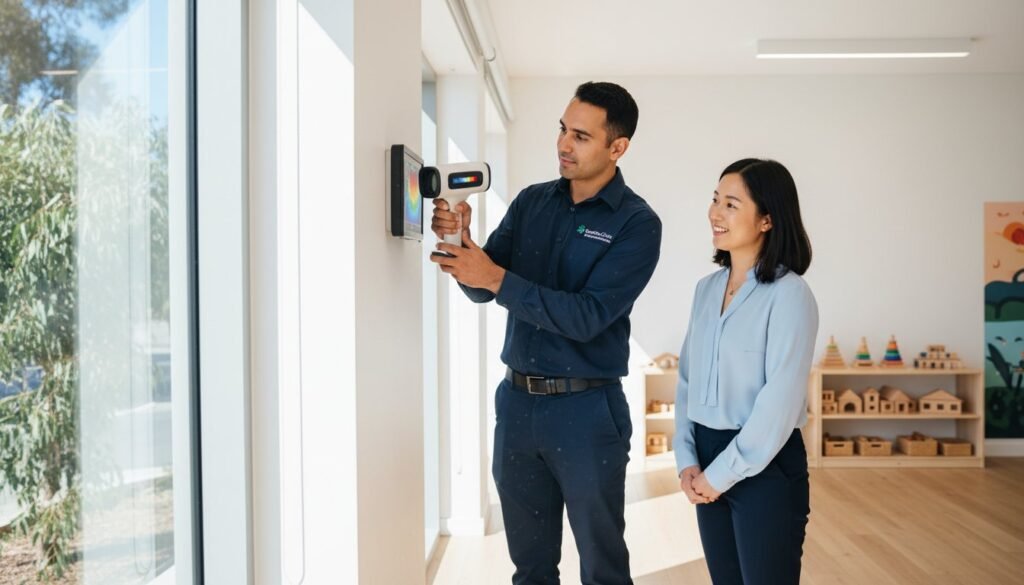
Our master technicians start with a high-detail visual sweep of high-risk zones. We focus on window seals where condensation pools and AC vents that may be recirculating airborne spores. In 2026, many Sydney centres use advanced soft play equipment that can trap moisture deep within foam layers, leading to persistent musty odours that cleaning alone won’t fix. During this phase, we perform moisture mapping. Moisture mapping is the non-invasive detection of water ingress that allows us to see behind play-area walls without damaging the structure. This is critical for identifying slow leaks from internal plumbing that often go unnoticed for months.
Step 2: Technical Testing and Data Collection
Visual inspections only tell half the story. We use air quality sampling to measure spore counts against outdoor baselines. If indoor counts are significantly higher than the air outside, you have an active growth problem that requires immediate remediation. We also perform surface swabbing to identify specific pathogenic species like Stachybotrys or Aspergillus. These species are particularly dangerous for children with developing lungs and are often the primary cause of respiratory complaints in childcare settings.
We distinguish between standard spore traps and Extensive Range Volatile (ERV) testing. While spore traps catch physical particles, ERV testing detects the chemical gases mould produces as it grows. To satisfy the latest NSW Health requirements, all samples are sent to a NATA-accredited lab for analysis. This third-party verification is the only way to legally prove your centre is safe for occupancy. When you receive your report, look for the comparison between “Elevated” and “Baseline” counts. If you’re concerned about hidden growth, it’s worth scheduling professional mould inspection services to get a definitive answer. It’s that simple.

Professional Assessment vs. DIY: Meeting Sydney Standards
Don’t reach for the bleach bottle just yet. Many centre directors believe a quick scrub with domestic cleaners solves the problem. It doesn’t. Bleach is primarily water; when applied to porous surfaces like drywall or timber, the chlorine stays on the surface while the water soaks in. This actually feeds the mould roots and encourages faster regrowth. A professional childcare centre mould assessment Sydney provides the scientific data needed to treat the source, not just the stain. Domestic janitorial tools simply aren’t designed to capture microscopic spores that remain suspended in the air.
The liability risks of a “quick fix” are too high to ignore. If a staff member or child suffers an asthma attack following an uncertified clean, your centre faces significant legal exposure. Scientific research on Molds and health problems highlights how even small amounts of airborne spores can trigger severe allergic reactions in sensitive groups. Professional remediation uses industrial grade HEPA vacuums and air scrubbers to physically remove these particles from your facility. Without a formal childcare centre mould assessment Sydney, you’re essentially guessing about the safety of your indoor environment.
The Hidden Danger of DIY Chemicals
Off the shelf mould killers often contain high levels of Volatile Organic Compounds (VOCs). These harsh chemicals can linger in high touch areas, posing a secondary health risk to toddlers who explore with their hands and mouths. We use biodegradable, non toxic solutions that are safe for sensitive environments. To understand the biology of what you’re dealing with, read our guide on What is Mould? A Complete Guide for Australian Homeowners. It’s that simple. Safe remediation requires a balance of effectiveness and environmental safety.
Insurance and Legal Compliance
Your business insurance policy likely has specific clauses regarding water damage and biohazards. Following a leak or flood, most insurers require a professional clearance report to maintain your coverage. This document proves that the building is structurally sound and biologically safe. In the event of a WorkCover dispute or a health complaint from a parent, a documented professional inspection is your primary legal shield. It shows you’ve exercised due diligence. We provide the master technician reports that protect your centre’s license and your reputation in the Sydney community.
Preparing Your Centre for a Mould Inspection
Preparation is the difference between a quick clearance and a multi-day headache. A thorough childcare centre mould assessment Sydney requires total access to the building’s envelope; from the subfloors to the roof cavities. If our master technicians can’t reach the source of the moisture, the assessment remains incomplete. You don’t need to shut down your operations, but you do need a clear plan. Following a simple preparation protocol ensures we gather the most accurate data without interrupting the children’s learning environment.
If you discover a major leak or a burst pipe before your scheduled inspection, take immediate action to stop the water flow. Turn off the main valve and use a wet-vac to remove standing water. Do not apply domestic cleaning chemicals or bleach to the area. These substances mask the biological evidence we need to sample and can interfere with lab results. Leave the area as is so we can accurately map the moisture spread and determine the risk level. It’s that simple. For urgent situations, you can rely on Sydney’s #1 Mould Removal Service: Safe, Fast & Guaranteed to handle the heavy lifting.
Minimising Disruption to Daily Routines
We recommend scheduling your childcare centre mould assessment Sydney for a Saturday or after 6:00 PM on a weekday. High activity levels during the day can stir up dust and debris, which sometimes skews air quality samples. If an after-hours visit isn’t possible, we can work room-by-room while children are in the outdoor play area. Ensure that all internal doors are unlocked and that staff are briefed on providing access to restricted zones like AC plant rooms or basement storage. You won’t need to move heavy furniture, but clearing toys away from the perimeter of the walls helps us use our thermal imaging cameras more effectively.
Parental Transparency and Trust
Parents in 2026 are highly sensitive to environmental health. Instead of keeping the inspection a secret, use it as an opportunity to demonstrate your “safety-first” culture. Draft a proactive update for your parent portal explaining that you are conducting a routine professional assessment to ensure the highest indoor air quality standards. This transparency builds immense trust and prevents rumors if parents see technicians on-site. Documenting these proactive steps is also a powerful asset during your next NQS rating cycle. If you are ready to secure your centre’s health rating, schedule your professional mould inspection today.
The Goldmorr Solution: Safe Remediation for Sensitive Spaces
Once your childcare centre mould assessment Sydney is complete, the focus shifts to total elimination. Many providers stop at surface cleaning. This is a mistake. Surface wiping removes the unsightly spread but leaves millions of microscopic airborne spores behind. These spores are what children inhale, leading to the respiratory issues discussed earlier. The Goldmorr System is the industry leading solution because it addresses both visible growth and invisible air quality risks simultaneously. It’s an Australian-owned system designed for high-standard environments where safety is the top priority.
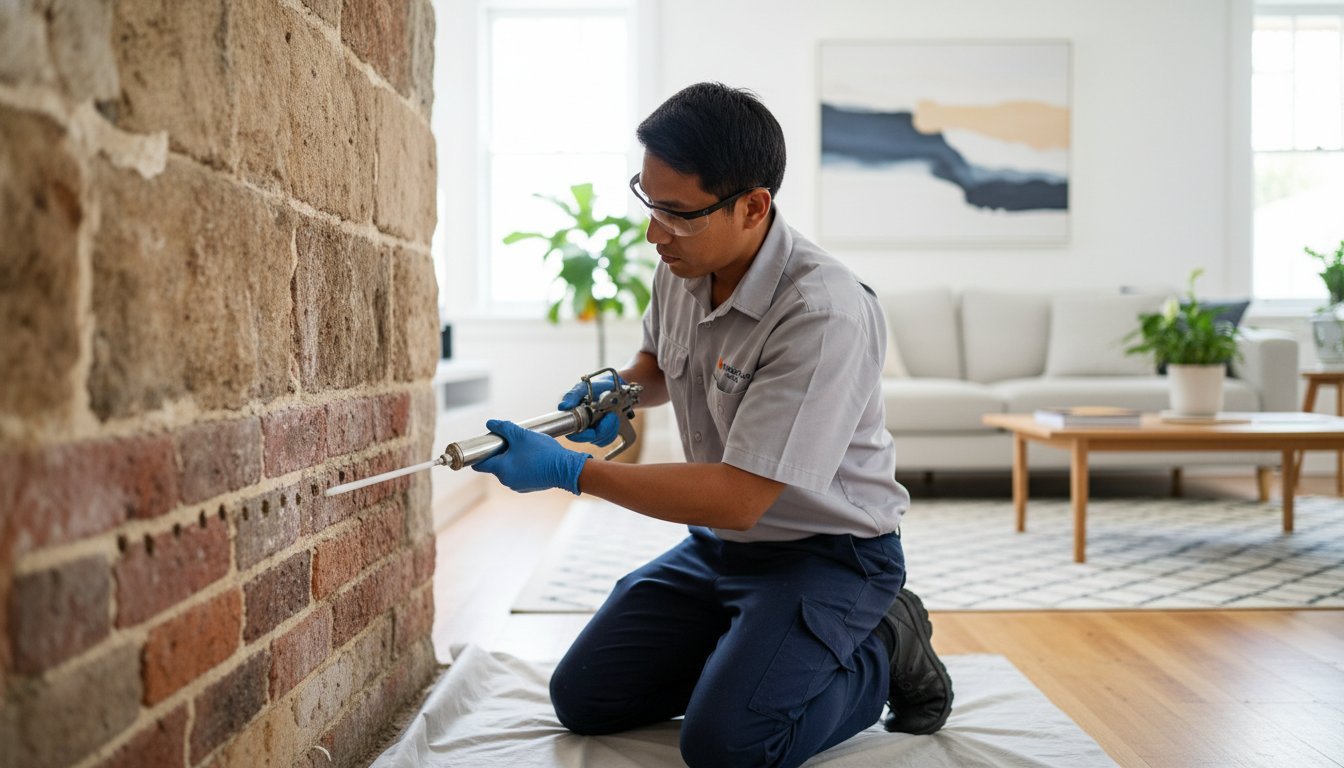
One of the biggest advantages for centre directors is our “no-sanding” protocol. Traditional mould removal often involves aggressive sanding of timber or drywall, which releases clouds of potentially toxic dust into play areas. Our master technicians use a specialized chemical process that eliminates the need for abrasive methods. This preserves the structural integrity of your facility and ensures no secondary contaminants are left behind. You won’t have to worry about a massive post-remediation cleanup. We maintain your centre’s cleanliness while restoring its safety. It’s that simple.
Biodegradable Fogging: Safe for Pets and People
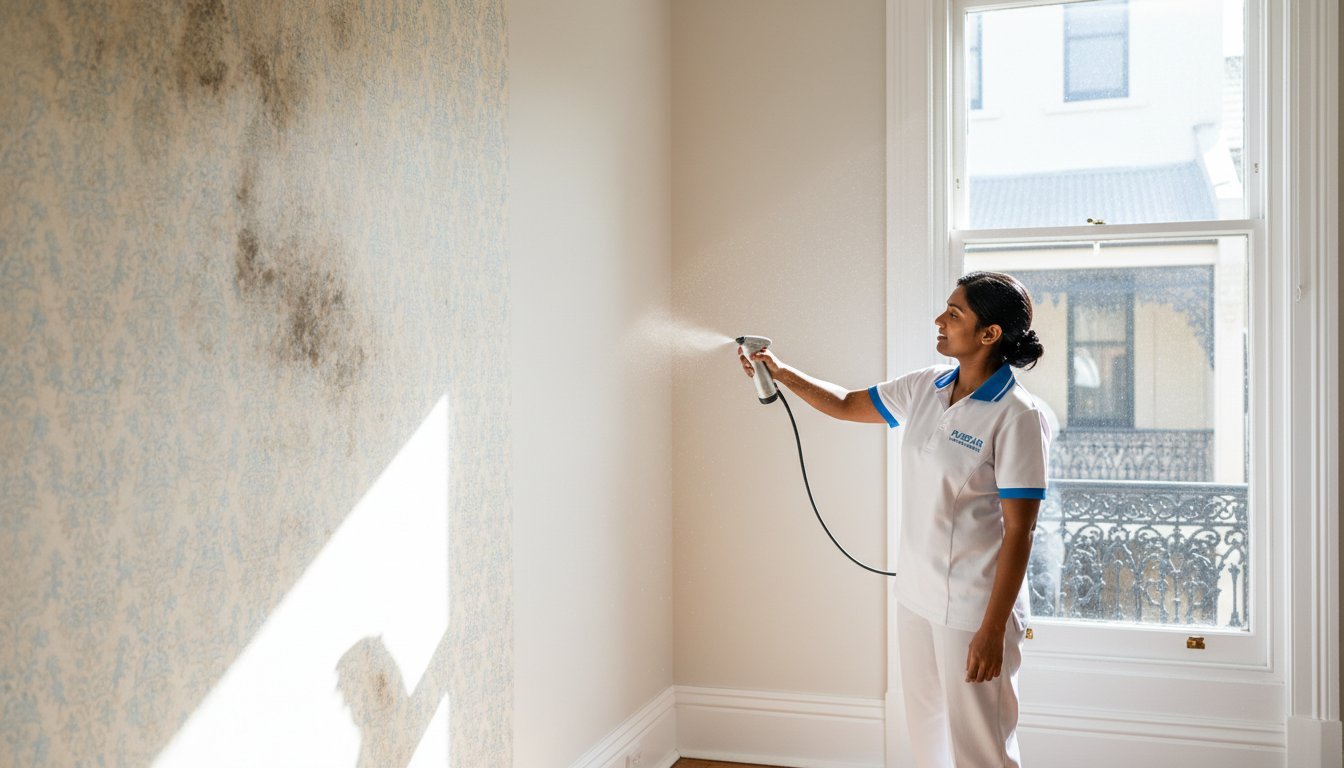
The core of our remediation process involves advanced air scrubbing and fogging. The Goldmorr System uses a biodegradable fog to neutralise airborne spores without toxic residue. This mist reaches into every corner, including air ducts, carpets, and behind heavy storage units where spores often hide. Because the solution is non-toxic and biodegradable, it is completely safe for children, staff, and even centre pets. This allows for rapid re-occupancy of the facility. In most cases, a centre treated over the weekend is ready for a full house of children by Monday morning with zero lingering chemical smells.
Next Steps: Get Your Professional Quote
Mould doesn’t stay static; it spreads. If your May 2026 assessment identified moisture ingress, you must act fast. Don’t wait until the problem worsens—because it will. A small patch of growth can contaminate an entire ventilation system in just 48 hours. ABC Mould Cleaning Solutions makes the remediation process affordable and transparent. We are committed to supporting Sydney’s early childhood sector, which is why we will beat any written quote by 10%.
Securing a pass on your next NQS audit requires documented professional action. We provide the comprehensive reports and clearance certificates you need to satisfy NSW Health and ACECQA requirements. Take the first step toward total peace of mind for your staff and families. Book your childcare centre mould assessment today. It’s that easy.
Secure Your Centre’s Health Rating Today
Managing a childcare facility in Sydney’s humid climate requires more than just standard cleaning routines. As the 2026 health standards tighten, a professional childcare centre mould assessment Sydney is the only way to ensure your indoor air quality meets strict NQS requirements. You’ve seen that surface cleaning is a temporary fix. Targeting airborne spores with the Goldmorr System provides a permanent, safe environment for developing lungs.
Don’t risk your reputation or your license by waiting for a health complaint. Our certified Goldmorr master technicians use safe, biodegradable solutions specifically designed for sensitive children’s environments. We are committed to keeping Sydney’s early learning centres safe and affordable. We will beat any written quote by 10%. Take control of your centre’s safety today. It’s that simple.
Schedule Your Childcare Mould Assessment Now & Get a Free Estimate
Protecting the children in your care starts with a clear report and a breath of fresh air. We are ready to help you pass your next inspection with flying colours.
Frequently Asked Questions
How often should a Sydney childcare centre have a mould assessment?
Sydney childcare centres should undergo a professional assessment at least once every 12 months. If your facility experiences a major leak or a period of prolonged humidity, schedule an immediate inspection. Proactive checks ensure your centre remains compliant with Regulation 103 and the latest 2026 NQS health standards. Waiting for visible growth is a mistake because moisture often hides in subfloors or wall cavities for months before it becomes visible.
Is the mould assessment process safe to conduct while children are in the building?
Yes, the inspection process is completely non-invasive and safe for children and staff. We use thermal imaging and moisture meters that don’t release any chemicals or dust. While we can work during centre hours, we recommend scheduling your childcare centre mould assessment Sydney after 6:00 PM. This ensures the air is still, providing our technicians with the most accurate spore count data possible for your clearance report.
What are the common signs of mould in a childcare environment?
Look for water staining on ceiling tiles, bubbling paint on walls, or persistent condensation on window tracks. A musty or earthy smell is also a major red flag for hidden growth. If 15% or more of your staff or children report unexplained coughing or watery eyes, it’s time to investigate your indoor air quality. These physical symptoms often appear before visible mould colonies manifest on play area surfaces.
Will we need to close the centre for the assessment or remediation?
You don’t need to close for an assessment, and most remediation jobs are completed over a single weekend. Our master technicians prioritize your operational continuity. By using the Goldmorr System, we avoid the need for heavy sanding or structural demolition. This means your centre stays clean and is ready for a full house of children by Monday morning. It’s that simple. It’s that easy.
Does a musty smell always mean there is a mould problem?
A musty smell is a definitive sign of active microbial activity, even if your surfaces look clean. These odours are caused by microbial volatile organic compounds (mVOCs) released as fungi grow. If you can smell it, your staff and children are inhaling it. A professional childcare centre mould assessment Sydney will locate the moisture source behind the smell and provide a permanent solution to eliminate the odour and the risk.
How long does it take to get a mould clearance report in Sydney?
You’ll receive a preliminary verbal summary on the day of the inspection. The final written report, including NATA-accredited lab results for air and surface samples, is typically delivered within 48 to 72 hours. This formal document serves as your clearance certificate. It provides the legal proof of due diligence required by NSW Health, ACECQA, and your insurance provider for the 2026 calendar year.
What happens if the assessment finds ‘Black Mould’ (Stachybotrys)?
Finding Stachybotrys requires an immediate, professional response to protect children’s sensitive respiratory systems. We set up physical containment zones and use negative air pressure to prevent spores from spreading to other rooms during the process. Our team then applies the Goldmorr biodegradable fogging process to neutralise the colony at its root. We don’t just clean the surface; we ensure the environment is biologically safe for occupancy.
Can our regular cleaners handle a mould outbreak?
No, regular janitorial staff should never attempt to clean significant mould outbreaks. Standard cleaning tools like mops and sponges don’t kill spores; they often provide the moisture needed for mould to spread further. Without industrial HEPA vacuums and air scrubbers, a DIY clean will release millions of spores into the air. Professional remediation is the only way to guarantee a safe, certified result for your childcare facility.